
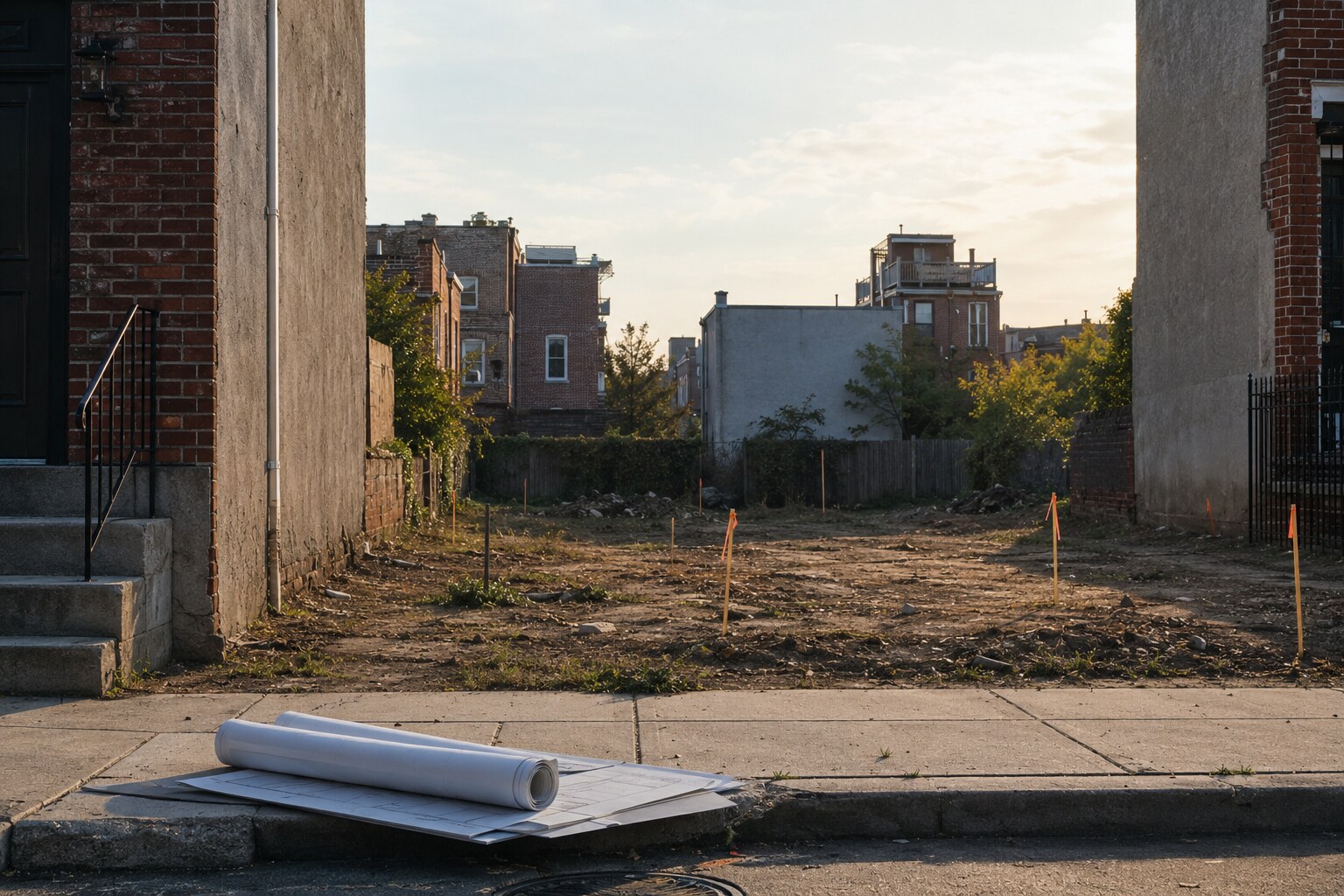
A site becomes a credible development opportunity only when the physical property, legal path, market demand, capital plan, and exit strategy support the same conclusion.
A development story is not yet a development strategy
Development sites are often introduced through a future image: a larger building, a new use, more units, or a transformed block. That vision can be useful, but it is not the starting point of my analysis. Before I become attached to what a property could become, I want to understand what the site can support, what must be proven, and which parts of the plan depend on decisions outside the buyer’s control.
In Philadelphia, a promising address can still carry difficult geometry, limited access, an existing structure, fragmented ownership, utility constraints, zoning questions, or a market story that does not justify the proposed scale. None of those conditions automatically disqualifies the opportunity. They do determine the work required to make it real.
I evaluate a development site by connecting five systems: site control, physical utility, regulatory path, market demand, and capital execution. If one system contradicts the others, the opportunity needs to be reworked before the price becomes the center of the conversation.
The strongest development concept is not the largest one. It is the one the site, market, and execution plan can support together.
Confirm what is actually controlled
Site analysis begins with control. A parcel shown inside a concept plan is not necessarily available, transferable, or controlled on terms that support the project. For an assemblage, I want to know which parcels are owned, which are under contract or option, which belong to third parties, and whether the project remains viable if one piece cannot be acquired.
This matters because the value of an assemblage is often nonlinear. One parcel may create access, frontage, circulation, parking, or buildable dimensions that the rest of the site lacks. Conversely, several adjoining lots may look compelling on a map without producing enough additional utility to justify the acquisition complexity.
Control also includes timing and authority. Who can make the decision? Are there estates, partnerships, lenders, occupants, tax matters, or other stakeholders that affect a transfer? What happens if closings cannot occur simultaneously? The sequence should be designed before capital is exposed, not after a critical parcel becomes the only thing standing between the buyer and the intended plan.
- Which parcels are controlled, and on what terms?
- Which parcel is essential to access, frontage, or usable dimensions?
- Does the project still work if an adjacent owner does not participate?
- Can acquisition timing be aligned through options, contingencies, or phased closings?
Read the physical site before the rendering
A concept can make nearly any site appear efficient. The property itself is less forgiving. I examine dimensions, topography, frontage, curb cuts, access, neighboring conditions, existing improvements, utilities, environmental considerations, and the relationship between the site and the surrounding block.
The question is not simply how much land exists. It is how much of that land can function economically. Setbacks, circulation, loading, fire access, stormwater, easements, structural conditions, and utility placement can change the usable footprint. A narrow parcel with strong frontage may support a different strategy than a deeper site with limited access. An existing building may contribute value, require adaptation, or impose demolition and carrying costs before new work can begin.
This is where professional diligence matters. Surveys, title review, environmental work, engineering, architecture, construction pricing, and utility confirmation each answer different questions. I do not treat a preliminary idea as a substitute for those disciplines. I use the early analysis to identify which questions can materially change the decision and should therefore be answered first.
Separate zoning potential from an approval strategy
Zoning is frequently reduced to a label or a maximum theoretical envelope. A serious development analysis goes further. The permitted use, dimensional standards, overlays, parking or loading requirements, existing conditions, prior approvals, and any requested relief all affect the path. Even when a concept appears consistent with the code, design, licensing, building, accessibility, and other requirements still shape execution.
When relief or another discretionary approval is required, I treat it as an uncertain event rather than an assumed outcome. The analysis should identify the decision-making body, likely process, professional team, expected timing, carrying cost, and alternative plan if the preferred request is delayed or denied.
That does not mean avoiding every project with entitlement work. It means matching price and transaction structure to the level of certainty. A buyer should not pay today for an approval that has not yet been obtained without understanding how that risk is being allocated.
Future rights may create value, but unverified rights should not be priced as though they already exist.
Make the market prove the program
A buildable concept can still be a weak investment if the market does not support the finished product. I want the proposed use, scale, unit mix, rents or sale prices, absorption, operating costs, and buyer profile to be supported by evidence appropriate to the location.
Philadelphia is not one uniform market. Demand can change block by block based on transit, employment, institutions, housing stock, retail, neighborhood identity, competing supply, and the quality of the immediate environment. Broad citywide numbers may be useful context, but they do not replace a site-specific demand thesis.
The program should be tested against the customer or capital source expected at the end. If the plan is rental housing, what will residents pay for this location and product after concessions, operating costs, and lease-up are considered? If the exit is a development sale, what will the next buyer require in terms of control, approvals, drawings, reports, or scale? If the project is intended for an owner-user, how does the site support that user’s operations better than available alternatives?
The market does not need to support every imaginable use. It needs to support the specific plan being underwritten and provide a credible alternative if that plan changes.
Work backward from execution and exit
Once the site, approval path, and market program are defined, I work backward from the intended exit. The plan must account for acquisition, professional services, approvals, demolition or site work, construction, financing, taxes, insurance, security, utilities, contingencies, lease-up or sales costs, and the time between each stage.
Timing is not a footnote. A six-month delay can affect interest, carrying costs, contractor availability, market conditions, and the return required by capital partners. I prefer a base case grounded in supportable assumptions, an upside case that does not depend on extraordinary conditions, and a downside case that remains survivable if approvals, costs, or absorption move against the plan.
The most useful development analysis ends with a decision, not merely a number. Proceed, restructure, obtain control, complete targeted diligence, reduce the proposed scale, pursue a different use, or decline. Each can be the right answer when it reflects the facts.
My approach is to let the property earn the story being told about it. A site becomes an opportunity when control, physical utility, approvals, market demand, capital, and exit logic reinforce one another. Until then, it is a possibility—and possibilities still need to be proven.
